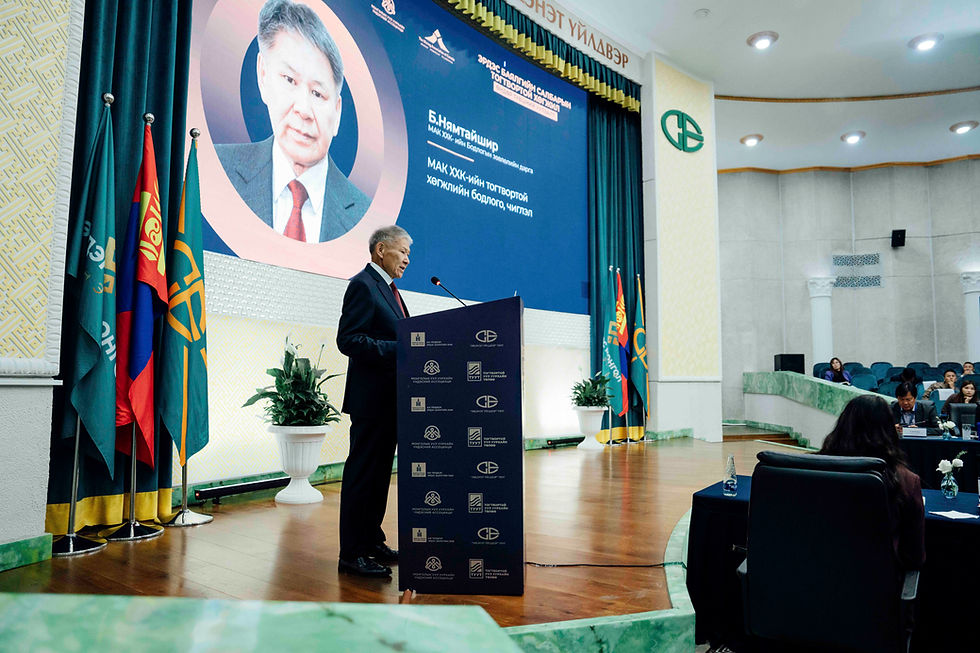
B.Nyamtaishir: Mongolia Lacks a Legal Framework That Fully Supports Projects of National Economic and Social Importance, Regardless of Whether They Are Public or Private
Updated: Sep 9

The following is an interview on sustainable development given to Mongolian Economy magazine by B. Nyamtaishir, Chairman of the Policy Council of Mongolyn Alt (MAK) LLC.
Mongolia successfully hosted the COP17 international conference last week. How would you assess the significance of the event?
In recent years, Mongolia has actively participated in major global conferences and events. Hosting an international conference of this scale and significance was itself another important step forward for the country.
However, the true measure of its success will be the practical and implementable decisions that emerge from the conference, how those decisions are put into action, and which institutions will assume responsibility for ensuring their consistent implementation.
For example, the Paris Climate Conference was held in 2015, and in 2016 more than 190 countries—including Mongolia—adopted and joined the Paris Agreement. Mongolia subsequently committed to reducing its greenhouse gas emissions by 22.7% by 2030. This commitment also provided the context for the President’s nationwide One Billion Trees initiative.
We must now ask what tangible progress we have made toward fulfilling our international obligations and commitments.
To mitigate climate change and meet those commitments, Mongolia must carefully assess the direct and indirect impacts of proposed measures, prioritize the areas that will deliver the greatest benefits, and formulate and vigorously implement a comprehensive state policy based on those priorities.
You mentioned the need for a comprehensive state policy. Could you elaborate on the sectors and policies you have in mind?
In my view, the state needs to introduce fundamental, reform-oriented policies in three critical areas: energy, petroleum supply and water.
Energy is the foundation of development. Yet even today, in the twenty-first century, smoke-belching diesel locomotives continue to operate across Mongolia. This is despite the fact that our country possesses world-class energy resources, including abundant solar, wind and coal potential.
Because Mongolia has failed to develop sufficient additional generation capacity, power outages have become increasingly frequent. Recently, the public appears to be accepting them as a normal occurrence. The colder months are approaching, and air pollution will once again become a pressing issue. When the power supply is unreliable, dependence on conventional polluting fuels inevitably increases.
We therefore need bold legal reforms to liberalize the energy sector and move it toward a competitive market model. Bureaucratic requirements—including excessive permits and technical conditions that can create opportunities for corruption—must be eliminated. The legal framework should encourage competition, reduce tariffs and facilitate investment.

Under current legislation, only power plant equipment is exempt from customs duties. My proposal is to extend customs-duty and value-added tax exemptions to all components required for newly constructed power plants, including structural steel, construction materials, transmission and distribution equipment, and related infrastructure.
In addition, newly commissioned power plants should be exempt from corporate income tax for their first three years of operation. Such measures would attract investment, expand generation capacity, improve transmission networks and reduce tariffs. Ultimately, they would also help lower air pollution and contribute positively to climate-change mitigation.
At its final meeting in August, the Government reportedly decided to submit a proposal to Parliament to exempt renewable-energy equipment and electric vehicles from customs and excise duties. This is a very positive step. However, the exemption should apply not only to electric cars but to all electrically powered machinery and equipment, and value-added tax should also be waived.
At a time when Mongolia is facing fuel shortages, these measures would reduce operating costs for businesses and steadily lower national petroleum consumption. They would also curb the outflow of foreign currency, reduce atmospheric CO₂ emissions and make a tangible contribution to meeting Mongolia’s international climate commitments.
How is petroleum supply connected to climate change?
The global geopolitical environment is extremely unstable, and its effects are already being felt by Mongolia’s economy and its people. Government officials repeatedly travel to our northern and southern neighbours to negotiate emergency fuel supplies, while citizens are forced to queue overnight at filling stations.
Mongolia had every opportunity to reduce its dependence on imported fuel, but the state failed to act and lacked a coherent policy.
An oil refinery is now under construction, but the project has taken many years and discussions continue to focus on its escalating investment cost. At the same time, the availability of domestic crude oil feedstock remains highly uncertain.
For many years, MAK has submitted clear and practical proposals to state leaders, Parliament and members of the Government. These proposals have called for urgent amendments to the Petroleum Law, accelerated petroleum exploration and more favourable conditions for attracting both domestic and foreign investment. Although the proposals have often been received enthusiastically, they have not been implemented.
Consider one example. The Government has granted 13 petroleum exploration licences covering a combined area of 138,600 square kilometres across Dornogovi, Umnugovi, Dundgovi, Khentii and Sukhbaatar provinces, all relatively close to the oil refinery. These licences are held by companies from China, Hong Kong, Australia and Switzerland, as well as Mongolian enterprises.
The licensed exploration areas are located in regions with comparatively well-developed infrastructure. Major rail networks—including the Ulaanbaatar–Zamyn-Uud and Tavantolgoi–Zuunbayan lines—cross or pass near these areas. The same is true of the 220 kV Ulaanbaatar–Mandalgovi–Tavantolgoi–Oyu Tolgoi–Tsagaan Suvarga transmission line and much of the 110 kV high-voltage network linking Ulaanbaatar, Choir, Sainshand, Zamyn-Uud, Baganuur, Undurkhaan, Zuunbayan and Ailbayan.

A limited number of targeted legal reforms could revive exploration activity. The Government should enter into agreements requiring exploration and production licence holders operating near the refinery to supply 100% of newly discovered and produced crude oil to the new domestic refinery.
In return, the Government should terminate the existing production-sharing agreements with the participating licence holders and renegotiate them under more favourable and flexible terms.
If the relevant legislation were amended to enable these measures, exploration would accelerate, investment would increase, the regulatory burden on businesses would decrease, and the refinery would have a greater likelihood of securing a reliable domestic feedstock supply.
Ultimately, Mongolia could reduce its dependence on imported petroleum and achieve tangible economic benefits. Investment returns would improve, production costs would decline and rail freight volumes would increase, alongside many other positive effects.
From a broader perspective, securing a reliable domestic supply of petroleum products should be viewed as strategic infrastructure for the energy transition and as a fundamental condition for mitigating climate change.
There is another distortion in the legal framework that must also be addressed.
The Petroleum Law uses the term “unconventional petroleum” and provides that its exploration and production are to be regulated under that law, including through production-sharing agreements.
However, oil shale—classified as “unconventional petroleum”—is a solid sedimentary rock that occurs underground interbedded with coal seams. Oil-shale exploration and extraction were previously regulated under the Minerals Law, but in 2014 they were transferred to the Petroleum Law.
In practice, oil shale exposed during coal mining is simply discarded in waste dumps. Once exposed to the atmosphere, it oxidizes, loses quality and becomes contaminated through contact with soil, making it unsuitable for future processing. This is a needless loss of a valuable resource.
Very few countries issue licences for minerals occupying the same geological space under two separate legal regimes. This contradicts the constitutional principle and the provisions of the Minerals Law requiring the comprehensive, non-selective use of natural resources. At the very least, these inconsistencies should be corrected in the legislation.

You also included water in the comprehensive policy areas you mentioned earlier. Why?
The President announced the One Billion Trees initiative from the podium of the United Nations. Under this programme, businesses and citizens are making significant efforts to plant and grow trees. But trees cannot grow without water.
At the same time, much of the industrial development driving Mongolia’s economy is concentrated in the southern Gobi region. The US state of Texas has climatic and environmental conditions broadly comparable to those of the Mongolian Gobi. In Texas, the use of groundwater for industry is restricted in certain areas, and industrial water is conveyed by pipeline from surface-water systems originating around the Rocky Mountains in Colorado. Mongolia also has options for transferring water. In my view, we must begin immediately to implement policies that ensure highly efficient groundwater use while supporting aquifer recharge and restoration.
Water is likely to become one of humanity’s most serious future challenges. Mongolia’s state policy should therefore allow the responsible use of a limited share of surface-water flows without disrupting ecological balance or violating international conventions and rules.
To achieve this, a network of wells could be developed around the confluence of the Orkhon and Selenge rivers. The water could initially supply Darkhan, then Ulaanbaatar, before being conveyed southward to the Gobi along the railway corridor.
Although this would require substantial investment, the project could potentially repay its costs through water-use charges. Because all life depends on water, it would also enable Mongolia to take meaningful action against desertification and expand the scale and impact of the One Billion Trees initiative.
It would further allow the water levels and ecosystems of the Kharaa and Tuul rivers, which have been used intensively for many years, to stabilize and would give their biodiversity time and space to recover.
What new projects is MAK implementing to develop environmentally responsible production?
MAK has begun feasibility studies for a project that would use oleaster, or wild olive, as a feedstock to produce 100,000 tonnes of sustainable aviation fuel (SAF) annually.
As part of the project, MAK has signed a cooperation agreement with a specialized Chinese company. The project envisions planting 20 million oleaster trees across 23,000 hectares and processing their fruit and seeds into aviation fuel.
Preliminary estimates indicate that the project could partially replace conventional jet fuel and reduce annual carbon dioxide emissions from the aviation sector by up to 350,000 tonnes.

Major projects inevitably encounter many challenges. What is the first and most significant obstacle they face?
Large-scale development projects financed by the private sector must pass through numerous administrative stages related to land allocation and use, rights to utilize common minerals, licences and other permits.
These processes delay project implementation, increase costs and reduce returns on investment.
By contrast, foreign-invested projects, state-funded projects and projects backed by government guarantees benefit from special streamlined arrangements. The oil refinery currently under construction is one example. Parliament has repeatedly adopted provisions to exempt the project from certain statutory requirements or to render those provisions inapplicable specifically to the refinery.
To give another example, MAK plans to build a road from Choibalsan to the Khavirga border crossing and has already completed the design work. However, to use common minerals from 16 locations along the route, the company must obtain separate licences. This requires exploration, resource estimation and approval, feasibility studies, environmental impact assessments, and the acquisition of land from local authorities through auction—among numerous other procedures.
Projects financed through the state budget, government loans or bonds, or backed by government guarantees, are governed by procedures adopted under a government resolution that allow the necessary rights to be granted directly.
This creates a starkly unequal business environment in Mongolia.
If completed, the road would enable uninterrupted, year-round transportation of mining products from the eastern region to the Khavirga border crossing. It would reduce transportation costs, increase export volumes and raise state-budget revenue through mineral royalties and corporate income tax. It would also contribute to Mongolia’s sovereign wealth fund. At a minimum, it would reduce wear on national passenger roads and improve road safety.
The same rules should apply equally to both public- and private-sector projects. Distinguishing between “private-sector projects” and “state projects” restricts investment rather than encouraging it. It also contradicts the Government’s stated commitments to creating a favourable business environment and ensuring a level playing field.
Mongolia therefore needs a legal framework under which projects of national economic and social importance are assessed according to their significance and impact, without discrimination based on their source of financing or form of ownership.
Source: Mongolian Economy magazine